
Come vibe chase with us: Engaging and playing sonic social media
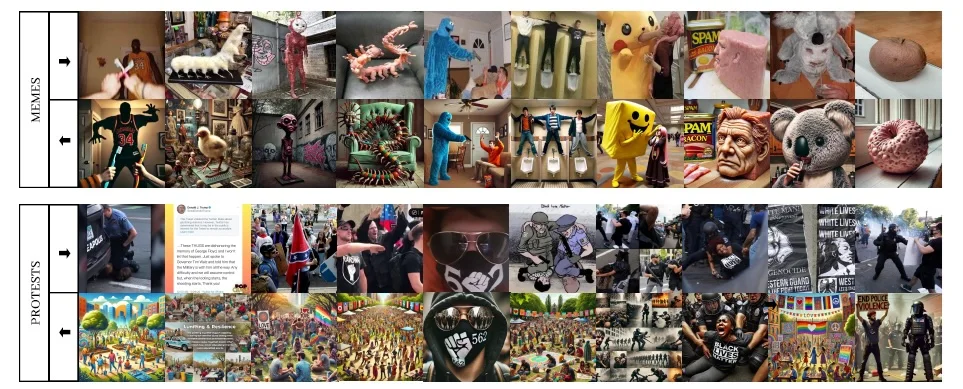
In the first volume of “Ambient Amplification: Memecry Across Platforms” published in Platforms & Society attention was shifted away from metrics and visible content toward the surrounding riffs, adaptations, and remixes through which platform engagement gains traction. From infrastructure toward culture and into the synthetic, amplification as ambient is discussed, departing from the premise that vibe supersedes content as the primary memetic substrate.
“Networked, clickable, and templatable sound objects are involved in the production of atmospheres that channel affect and resonate across personalized algorithmic feeds. Sound, as a strong affective vector for presencing, propaganda, and play, is deeply entangled with its platform surroundings, extending into the broader connective infrastructure. […] Attention oscillates between algorithmically attuned spaces organized around similarity and more diverting encounters with searchable hashtags, emojified comments, and moving images” (Pilipets & Geboers 2026: 3).
An open call is now out for contributions to a second volume. Through the lens of “ambient amplification,” the special theme attends to the growing centrality of peripheral awareness in contemporary platform cultures. Much of what shapes attention online arrives indirectly – as recurring recommendations, familiar gestures, recycled speech, reposted links, synthetic likenesses, shareable sounds, and other affective cues that reemerge across platforms. Within platform systems designed to operationalize engagement as data, intentional connection gives way to a variety of background signals. Media snippets once tied to specific temporal and spatial constellations operate atmospherically through persistent exposure rather than direct impact. AI-driven meme wars, brainrot, and slopaganda – all recent symptoms of attention-driven platform ecologies – point to forms of appropriation grounded in atmospheric familiarity. Generative AI affordances, alongside social media affordances for recommending, remixing, and reposting, give rise to ambient forms of memetic riffing and affinity-based algorithmic approximation.
If Volume 1 sketched out these conditions by tracing the cross-platform manifestations of ambient amplification through memecry as a relational mode of cultural production sustained by imitation, affective attunement, and algorithmic modulation, Volume 2 explicitly turns toward the atmospheric conditions of riffing on vibes. Vibes, we suggest, are more than an aesthetic supplement to content – viral or memetic. Approached as a means of ambient amplification, vibes affect how we navigate the diffuse elements – interactions, recommendations, interfaces, profiles, feeds – that platforms fold into one all-encompassing engaging atmosphere. Vibe chasing names an orientation toward what feels emergent or likely to catch on. Extending Steve Goodman’s (2009: xvi-xx) attention to the “bad vibes” of sonic memetic warfare mapped across several research articles on ambient propaganda in Volume 1, the discussion opens onto Robin James’s account of “good vibes” (2026) as a critical lens on how algorithms model possibilities of cultural orientation through vectors – or “directional intensities that constitute the algorithmized social body” (Chatonsky, 2025).
Volume 2 encourages contributions inspired by vibes-based methods (Watson 2025) and intersectional accounts of platforms as “mood-altering devices” (Therieau 2022) that tap into algorithmic pattern recognition and prediction (Grietzer 2017). It invites sound studies scholars to tune into platform attention economies, affect theorists to map cross-platform forms of atmospheric escape, and media researchers to explore embodied expression as a key experiential dimension of synthetic platform culture shaped by generative AI. Across contributions, the volume asks along which trajectories vibes accumulate force, how ambient states of belonging take shape within algorithmic regimes of inclusion and exclusion, and what forms of power emerge wherever amplification takes hold.
We particularly welcome contributions engaging with:
-
Audiovisual platforms: how voices, music, gestures, images, sounds, and other audiovisual fragments acquire atmospheric force as they are sampled, remixed, recommended, and recirculated across platforms; and what combinations of methods are needed to trace these relations.
-
Affective infrastructures: how algorithmic systems of pattern recognition and prediction identify, cluster, anticipate, and amplify cultural tendencies; how platforms translate affective affinities into computable patterns; and what remains ambiguous or resists capture in this process.
-
Embodiment and presencing: how vibes are sensed, performed, inhabited, and made present through bodies, interfaces, feeds, profiles, and mediated encounters; and how affect-theoretical, cultural studies, feminist, queer, critical race, and disability perspectives can address whose bodies become perceptible, amplified, or excluded.
-
Vibe chasing as cultural practice and method: how user communities, brands, creators, and political actors orient themselves toward emergent events; and how vibe-based, sensory, speculative, ethnographic, or experimental computational approaches grounded in platform data can move beyond metrics and content to trace riffing on affective orientations and forms of ambient amplification.
-
Generative AI, synthetic vibes, and slopification: how generative AI participates in the approximation, recombination, and scaling of familiar cultural patterns; and how generative systems and platform infrastructures converge in the production of likeness and the anticipation of what we are likely to vibe with.
If you are an interdisciplinary scholar interested in these and/or related fields, we warmly encourage you to submit a max. 500 abstract to the special theme guest editors at elena.pilipets@uni-siegen.de and m.a.geboers@uva.nl
Abstract submission deadline: 30 November 2026
Decisions communicated: Mid-January 2027
Selected authors will be invited to submit a full manuscript to Platforms & Society. Please note that an invitation to submit does not guarantee publication. All manuscripts will undergo the journal’s standard double-blind peer-review process.
We are looking forward to your contributions!
Elena & Marloes